Powered by Blogger.
Showing posts with label Donald Trump. Show all posts

Friday, February 11, 2022

Covering “Fake News” and disinformation


It is interesting to observe how the term “fake news” was created and how worldwide it became. Although the expression was first used by Donald Trump to undervalue unfavorable news about him, it turned into a much bigger problem that occurs in many different countries. And they all nominate it as fake news as well. 

Credit: Pixabay

The first point I recognized as important about this subject is to wrongly call it “fake news”. As Claire Wardle from First Draft said here, we have to be clear when we use that term. “Are we talking about disinformation? Are we talking about misinformation? Are we talking about pollution? Are we talking about propaganda?”. Otherwise, if we don’t be direct about it, we are just going to endorse the battle against the news industry and contribute to the generalized skepticism towards it reaffirming that it sells false information. 

Secondly, is the effect fake news has on making people believe in falsehoods, how it has changed their perception about truth, and their opinion of the importance of the news, of being well informed. The fact that part of the audience is dropping some outlets and consuming less information is a relevant risk to the media environment. Regardless of whether it is because they don’t like it or if that contradicts their bias, having a non-informed population is harmful to society overall. 

Propaganda and advertising

Speaking of disinformation, a topic that also highlighted to me was the use of propaganda and advertising in the form of news articles on media outlets. They look exactly the same, with headlines, photos, and polished writing, but are created by, or on behalf of, a paying advertiser. As a blog and magazine reader, I have seen thousands of these ads and haven’t given much value to them because I knew they weren’t 100% truthful. However, many people do not have the same understanding I do. 

Therefore, reading and thinking about it made me realize how this strategy called “native advertising”, but also tagged as “partner post” or “sponsored content”, can be prejudicial and deceive the public. Research studies have shown that those labels are ineffective at helping readers distinguish between an editorial and an advertising type of content. 

As an example, I will quote Michelle A. Amazeen’s article (Researchers looked at nearly 3,000 native ads across five years. Here’s what they found) published on Nieman Lab

“Philip Morris International, the tobacco company, ran a native advertising campaign across many media outlets, including The Boston Globe, The New York Times, Reuters, and The Washington Post (…) about the ‘disinformation campaigns that muddy the truth’ regarding the benefits of vaping products while themselves muddying the truth.” 
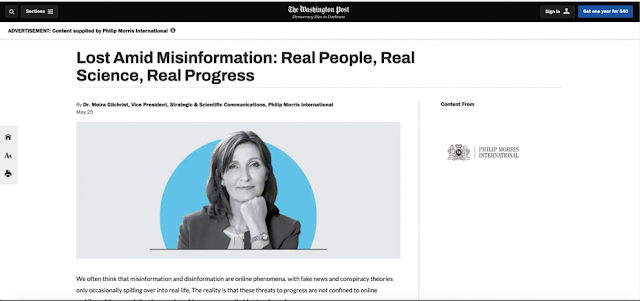

Another concern is that this kind of text is made by journalists. Many media companies have now content studios just to create native advertising in the name of corporate clients. It is understandable that a company needs money to survive and that it comes mainly from ads. Nevertheless, they should be responsible for the kind of content they publish and aware that it also might influence real journalism. 

Lastly, I want to rebound on Claire Wardle’s opinion about the challenge for the next two years. In 2017 she said it was “going to be a mixture of new technologies and how manipulation and disinformation work on those platforms and through those technologies.” By now, in 2022 – five years later, it seems like the challenge she mentioned is still pertinent and will last longer in the future.

References:


Graham, David A. 2019, Some Real News About Fake News, The Atlantic, accessed 13 February 2022, <https://www.theatlantic.com/ideas/archive/2019/06/fake-news-republicans-democrats/591211/>.


Wang, Shan 2017, The scale of misinformation online is global. First Draft is pushing for more collaboration — and more research — as an antidote, Nieman Lab, accessed 13 February 2022, <https://www.niemanlab.org/2017/11/the-scale-of-misinformation-online-is-global-first-draft-is-pushing-for-more-collaboration-and-more-research-as-an-antidote/>


Berman, Nina 2017, The Victims of Fake News, Columbia Journalism Review, accessed 13 February 2022, <https://www.cjr.org/special_report/fake-news-pizzagate-seth-rich-newtown-sandy-hook.php>.


*This article was submitted as a memo assignment for the course "Current Issues of Journalism" at the University of Illinois.
Published: By: Manu Ferreira - 2/11/2022 02:17:00 PM

Sunday, January 30, 2022

Journalism during the Trump administration


Over the decades, Journalism coverage has passed through several changes. We can include in that bucket of challenges, the transformation and evolution of media, and social episodes that happened, such as wars, elections, Nazism, racism, democracy, pandemics, and so on. The last challenge we have faced was the Donald Trump administration. Not that it had been as devastating and killer as the examples above, but because, in a certain way, it contained all of those problems involved at the same time. 

Donald Trump | Credit: Pixabay

In a situation like that, journalists and reporters needed to find a way to manage the crisis and inform people despite all objections. The most important premise that was supposed to be kept in mind was, as CNN said in its promo video, the focus on “facts first”. But did we get out of that track? 


The first problem I found was how some news organizations were euphemistic and reticent in calling all Trump’s untruths “lies”, even though fact-checkers had shown that thousands of his claims were falsehoods. If the focus of journalists is true stories, their role must include checking the “alternative facts” and exposing them the way they are. Or, which is even worse, to use impersonal language like talking about the failures of “Congress” when what is meant is “the Republican Party”’, as quoted in the Columbia Journalism Review (CJR) article. 


How to choose what will be news?
Another point that caught my attention is the power we have, while journalists and editors, to choose the news that is going to be covered and how they will be covered, and more important: our ability to concentrate on relevant matters. It can be easily exemplified with the rape and sexual assaulting accusations that did not receive the coverage they deserved, because some other scandals appeared in the same week. This also connects to episodes when Trump or his supporters would release new pieces of information to make a buzz and distract the media from another unwanted subject, which reinforces that we have to be aware of these disinformation strategies and know how to respond to them. 


Something that has contributed to this age of misleading information is social media. Donald Trump recognized its potential and used it constantly to share wrong data and fake news that many people believed was real. And that brings us to another challenge: How to combat them when the content is promoted in such a powerful media that reaches millions of people in a few seconds? 


The answer is revealing the truth, even if it won’t receive the same amount of likes or shares, and even between an audience who was primed to view journalism as dissent 


An example of an improvement came from Wisconsin

Among many problems, however, I see improvements. From the beginning of the president's mandate to the end, many news sources fought against misleading information. One specific case I recognized as very interesting, was during the elections and all the falsehoods about fraud in the ballots. In the middle of so much pressure, the politics reporter for the Milwaukee Journal Sentinel, Patrick Marley, opted to hold on covering the story until the state elections commission officially announced that no Wisconsin ballots were among the discarded mail 


It highlighted to me how important is to wait to gather the right information, instead of just publishing it without checking and making sure that it was true, and confronting it with the fake news. In this particular story, the reporter put Trump’s claims in context, showing them against the backdrop of Trump’s previous assaults on mail-in voting and connecting mail issues to funding cuts and related slowdowns at the United States Postal Service. 


I agree with the CJR reporters Jon Allsop and Pete Vernon when they say that the systemic problems faced during Trump’s administration were here before and will last long. The solution for these journalism failures will take a while to happen. 


References:


Allsop, Jon; Vernon, Pete 2020, How the press covered the last four years of Trump, Columbia Journalism Review, accessed 28 January 2022, <https://www.cjr.org/special_report/coverage-trump-presidency-2020-election.php>.


Karbal, Ian W. 2020, How careful local reporting undermined Trump’s claims of voter fraud, Columbia Journalism Review, accessed 28 January 2022, <https://www.cjr.org/covering_the_election/voter-fraud-local-journalism.php>.

*This article was submitted as a memo assignment for the course "Current Issues of Journalism" at the University of Illinois.
Published: By: Manu Ferreira - 1/30/2022 01:22:00 PM