Powered by Blogger.
Showing posts with label Memo. Show all posts

Friday, April 22, 2022

Global journalism ethics in a time of nationalism and populism

In order to better understand the relationship between global journalism ethics and nationalism and populism, I first looked for the definition of the “isms”. In the article “Nationalism and Populism: What is the difference? How are they connected?” by Liberties, the author defines Nationalism as a “belief and political ideology that the sovereignty, interests, and identity of one’s own nation take precedence over other states and groups of people.” Populism is described as a “political strategy of appealing to “the people” in opposition to ‘elites’ who are making the lives of ‘the people’ worse.” 

Credit: Pixabay

Understanding the meanings was important to observe how society has changed due to the use of these strategies and how they contributed to the shift in people’s attitudes towards the media. Moving forward, it was relevant to realize how global journalism ethics is necessary to help solve that issue. 

In the article “Global journalism needs global ethics”, published by The Conversation, Christopher Kremmer mentions the book Radical Media Ethics: a global approach (2015) and how the author claims that “in a global, media-linked world where stories cross borders and can inspire positive change – but also incite massive violence – we need globally-minded journalism.” 

As Stephen J. A. Ward says, new forms of communication are reshaping the practice of journalism at local, regional, national, and international levels. One of the imperatives of global journalism ethics states that journalists must act as global agents with a focus on serving the citizens of the world. “The goal of their collective actions is a well-informed, diverse and tolerant global “info-sphere” that challenges the distortions of tyrants, the abuse of human rights, and the manipulation of information by special interests.” 

That implies being objective to avoid bias, being accurate and balanced, and producing content with relevant international sources and multiple perspectives. Global journalism also asks journalists to be more conscious of how they frame the global public’s perspective on major stories. According to Ward, “Public duty calls for independent, hard-edged news, along with investigations and analysis.” 

In my opinion, the set of principles and standards for the practice of journalism proposed by Ward is the way to survive this age of nationalism and populism. We, as journalists, have to stick to the basic core and values that the profession implies: be objective, accurate, factual, and serve the public but, in addition, carry a global perspective, embracing diversity. 

Globalization and digital disruption brought us into a different world. To keep up with the constant changes, journalism ethics needs to re-invent itself. It must decide which principles can and should be preserved, while other ideas are no longer maintainable. To sum up, I agree with Kremmer when he says that “if the purposes of our work, and how it is funded, and the methods we use to perform it change, ethical principles can and do evolve to meet the changed realities.”

*This article was submitted as a memo assignment for the course "Current Issues of Journalism" at the University of Illinois.

Published: By: Manu Ferreira - 4/22/2022 10:53:00 AM

Friday, April 15, 2022

Threats to journalists and security. Who is monitoring this and what is being done?

Journalism can be a dangerous profession. Committee to Protect Journalists (CPJ) data shows that 1,400 journalists were killed around the world in the last 30 years. In addition, 1864 professionals were imprisoned and 69 missing. And most of that happened just because they were doing their jobs. What makes it even worse is that data collected in 2021 by UNESCO reveals that the impunity rate in the killings of journalists is 87%. 

Credit: Pixabay

A survey conducted by the Radio and Television Digital News Association (RTDNA) found that in 2020 one in five television news directors “reported attacks on employees and 86% of news directors purchased bulletproof vests and gas masks and sent security teams with reporters more often.” While more than half of the attacks occurred during coverage of protests, riots, or rallies, 15% happened randomly while teams were on the field. 

Professor Marty Steffens, a professor at the Missouri School of Journalism, highlighted in an interview with CPJ how Donald Trump played an important role in the shift in police behavior toward journalists. “By fomenting the idea that the press is the enemy of the people…you really put journalists in the bullseye. Because the president pushes back against journalists and doesn’t respect them, local officials are empowered to do the same thing.” 

Those numbers do not mention the other forms of violence and intimidation, such as threats, retaliation, and persecution online, including harassment, abuse, and hate speech. In The Washington Post article “Being a journalist in the U.S. is becoming more dangerous”, Jason Rezaian says that “many journalists have endured years of online harassment and abuse in silence. The industry has become desensitized to these attacks, accepting them as an occupational hazard.” 

What is being done

When we look for who is monitoring threats to journalists, we can find some organizations that are collecting data, such as CPJ and the Press Freedom Track, a database of press freedom incidents in the U.S. It documents cases of arrests of journalists, seizure of their equipment, assaults, and interrogations at national, state, and local levels. However, is not easy to find what is being effectively done to stop the attacks and protect media professionals. 

In 2013, the UN published a plan of action on the safety of journalists and the issue of impunity. It provides a framework for cooperation between UN bodies, national authorities, media actors, and NGOs to create a free and safe environment for journalists and media workers, both in conflict and non-conflict situations. 

More recently, in July 2021, Senator Ron Wyden introduced the Protect Reporters from Excessive State Suppression (PRESS) Act. The proposal establishes rules for how and when the government can use a compulsory process to obtain information about journalists working within the scope of news gathering, which includes data held by third parties like phone and internet companies. It was read and referred to the Committee on the Judiciary but, according to the Congress website, nothing has been done since then. 

Speaking of online issues, a coalition of groups including CPJ and the International Press Institute created an Online Violence Response Hub to help journalists that deal with digital hate and violence. It offers safety consultations and other resources. 

And CPJ along with the Free Press Unlimited and Reporters Without Borders have launched a People’s Tribunal on the Murder of Journalists to investigate attacks around the world. It consists of five hearings, taking place from November 2, 2021, to May 3, 2022. 

In conclusion, any efforts to raise awareness about the safety of journalists are essential. As Sissel McCarthy says in her article “What is being done to protect journalists?” on News Literacy Matters, “an attack against a journalist is an attack on you and your access to fact-based information. When journalists can’t do their job, people in power are not accountable for their actions. That can lead to an environment ripe for corruption, censorship, and even war.”

*This article was submitted as a memo assignment for the course "Current Issues of Journalism" at the University of Illinois.

Published: By: Manu Ferreira - 4/15/2022 08:38:00 AM

Saturday, April 9, 2022

Broadcast Video and Audio: old ways and new ways

It seems like almost all of the current issues we have nowadays come down to two reasons: money and technology. From its creation to its evolution, technology/the internet has changed everything around us. In journalism, it started with the printed newspaper’s decay and it’s walking towards a broadcast decay in the future as well. 

Credit: Pixabay

As mentioned in the Reuters Institute’s report “What Is Happening to Television News?”, TV viewing has declined by 3 to 4% per year on average since 2012, which if compounded over ten years will result in an overall decline in viewing of 25 to 30%.


The special report “Fading ratings” published by Variety in January 2022 shows that just 12 out of 124 measured networks saw an increase in average primetime audience in 2021 when compared with 2016. It means that 90% of networks experienced a decline ranging from two thousand to several million viewings. 


Variety’s report also reveals that broadcast networks have seen “tremendous primetime audience declines” having CBS as an example that has shed 3.2 million viewers since 2016. It is important to note that despite the decline, CBS still had about 5.6 million primetime viewers in 2021, which is an expressive reach, enough to lead the TV industry. However, the drop in those numbers is not a good sign in the long term. 


The audience has shrunk with the growth of new streaming platforms and video-on-demand providers, like YouTube, Facebook, Netflix, Amazon Prime, Hulu, and social media. Studies have shown that the majority of TV viewers now are 60+ years old, while the young generation most likely has digital media as news sources.


“There are thus no reasons to believe that a generation that has grown up with and enjoys digital, on-demand, social, and mobile video viewing across a range of connected devices will come to prefer live, linear, scheduled programming tied to a single device just because they grow older,” affirm Nielsen and Sambrook in the Reuters’ report.


Broadcast survival depends on how much and how quickly we can adapt to the changes and recalculate routes. The silver lightning is that technology can also be a solution.

What we can infer from this digital and mobile age is that is affecting the news cycle, from gathering to production and consumption. To reach younger generations, TV providers need to invest in innovation and experimentation in both formats, storytelling methods, length, and distribution strategies to remain relevant. It has to be short, visual, dynamic, and timely. 


In my opinion, the biggest challenges in terms of content are adding value to stories that have already been shared on several websites and social media, and reporting complicated stories in real-time. But it is one of the skills a journalist needs now and will need even more in the future.


I agree with Gavin Bride when he says in Variety’s article “The future of TV news won’t be on TV” that the solution for broadcast is “to knock down the walls and distribute everywhere free and ad-supported: FAST services (and not exclusively on one platform), live streaming and feeds on social media. The new consumers expect content to follow them, not the other way around.” 


I couldn't find a current estimate of the total sum made on ads, but in 2019 the CEO of Xumo, Colin Petrie-Norris, said that "on just ad-supported content with a low-end load of 15 to 17 ads per hour on average, as a channel, you can be earning between 15 cents to 80 cents an hour per viewer." 


Considering that these channels have millions of users, it's not a bad deal. Variety's 2021 report showed that Roku had 55.1 million active accounts, Xumo had over 24 million, Peacock had 20 million, and Pluto TV had 52.3 million global monthly average users.


And it keeps growing. According to data from Kantar, 18% of U.S. households now use at least one free ad-supported TV service as of the fourth quarter of 2021, more than doubled since 2020. YouTube announced it will stream free ad-supported TV shows for the first time to compete with the growing number of FASTs on the market. It is also an opportunity to reach consumers that can't afford cable TV. Another reason is that it can boost distribution and use this visibility to invite people to subscribe to other exclusive content the providers may produce.


In conclusion, journalists and news outlets, in general, must use social networks and all digital platforms available to reach the audience and get closer to them. More than distributing content, they can make this new generation more involved and engaged to express their opinions and suggest topics.


Credit: Pixabay


*This article was submitted as a memo assignment for the course "Current Issues of Journalism" at the University of Illinois.

Published: By: Manu Ferreira - 4/09/2022 09:11:00 AM

Monday, April 4, 2022

New business models for journalism: profit, nonprofits, and hedge funds

One of the reasons used to explain the crises in the journalism market is profit – or lack of it. We have to agree that it’s hard to compete with giant tech as Facebook and Google when it comes to advertising, which has been the main revenue resource for media outlets for years. 

Credit: Pixabay

However, if everything has been consistently changing due to technology, the key to survival is to change and rethink the business models to find an applicable alternative to make a profit meeting communities’ needs instead of laying off journalists and shutting down newsrooms. It's known that when local newspapers disappear, the society responds with less civic engagement, more polarization, misinformation, corruption, and dysfunction. 

As Steven Waldman and Charles Sennott say in their article on Report for America, “we need a radical shift in our thinking about local media models, including a different attitude toward the role nonprofits play in journalism.” Non-profits are as innovative as commercial outlets, with the addition of quality content rather than sensationalism and quantity of views. 

Nonprofit news is often more representative, responsive, and more closely tied to local communities. Since they don’t pay taxes on their income, their activities must serve the public and not the interests of owners, shareholders, or politicians. 

I was pleased to find that many non-profits are creating and investing in new business models and that they are doing well despite all difficulties. The co-op, in particular, seems to be an outstanding option for me. The idea of having readers as part-owners and having them participate in editorial and business decisions is very interesting. It’s a way of compelling the audience and making them feel an active part of the whole news process. 

Another engaging model has been used by Chicago’s City Bureau on the project called “The Documenters”. It trains people to collect information from their communities and neighborhoods. They can participate in government meetings, and enhance their knowledge, relationships, and capacity to create a new information resources. 

Engaging the audience is also important to have them advocating for the local news cause. One instance is what happened in New Jersey. With a push from Free Press and the public, the State created the Civic Information Consortium, which will give grants to collaborative projects that improve access to information, storytelling, and newsgathering. 

In the article “Nonprofit journalism finally builds scale” published by NiemanLab, Jim Friedlich says that in 2022 several nonprofit news organizations are accelerating their growth. He mentions that The Texas Tribune has continued to grow and inspire other organizations, and Spotlight PA now distributes its content to over 75 newsrooms in Pennsylvania reaching over 35 million visitors monthly. 

Other enterprises plan to launch with corporate resources and commercial models rarely seen in nonprofit news. Such as The Baltimore Banner, which will be launched with an annual budget of $15 million and will sell subscriptions to support its operation, and Chicago Public Media, which will be completely acquired by the Chicago Sun-Times. 

To sum up, I agree with Friedlich when he says that nonprofit news has created meaningful new reporting capacity for journalism, but its long-term success and impact depend upon it becoming a much larger and smarter business. “Enlightened new capital, business acumen, and a capacity to build at scale are required to truly rebuild — indeed, reinvent — American local news.”

*This article was submitted as a memo assignment for the course "Current Issues of Journalism" at the University of Illinois.

Published: By: Manu Ferreira - 4/04/2022 09:22:00 AM

Saturday, March 26, 2022

International Investigative Journalism: What are examples of it? How has it evolved?

In an era of the internet, social media, fake news, and newsrooms layoffs, investigative journalism is more than necessary. In-depth reporting based on verified facts is one of the solutions to combat misinformation in shallow media coverage. 

Credit: Shutterstock

Despite its relevance, it appears that investigative journalism is under threat since journalists have been losing their jobs due to the transformation of the media's business model. That is explained by the fact that investigative journalism takes time and is expensive to produce when compared to a regular news story. Sometimes it requires a team of journalists, photographers, videographers, editors, data scientists, and lawyers.


However, technology has been an ally and has changed media coverage, especially when it comes to international investigative journalism. Nowadays is possible to involve professionals from all over the world to report in-depth stories. As an example, I would mention The Ericsson List, an investigation led by the International Consortium of Investigative Journalists (ICIJ), which counted with the collaboration of journalists from 19 countries, and had media partners from more than 20 countries.


A second example is the ICIJ’s “U.S. Aid in Latin America” investigation that inquired how anti-drug money is funneled through corrupt military, paramilitary, and intelligence organizations and violates human rights in Brazil, Colombia, and Mexico. And, of course, the Wikileaks case, in which its publications mobilized the media in the whole world.


Bringing it into current days, we can also observe the use of technology in how journalists covering the war in Ukraine have been using WhatsApp, Telegram, and other messaging apps to communicate, share news, and keep track of their moves for security purposes. As Joel Simon says in the article “For journalists, Ukraine is a WhatsApp war”, published on CJR, “WhatsApp and Signal groups connect colleagues in the field—and provide a level of real-time battlefield information that, a decade ago, would have been available only to a top general.” 


AI and Machine Learning

Besides connecting people and information, technology like AI has powered investigative journalism. Machine learning can analyze massive datasets in less time to identify leads, name, and predict misclassifications. Emilia Díaz-Struck, research editor and Latin American coordinator for the ICIJ, said in the article “The impact of AI and collaboration on investigative journalism” (here) that there is a lot of potential in using machine learning for journalism when dealing with vast amounts of data. “For these kinds of investigations, it would take years to manually go through and screen millions of records and make sense of them.”


Nevertheless, reporters are still required to do their work as well, such as talking to sources and cross-checking the data with public records. “Machine learning can help us find a needle in a haystack, help us be more efficient, and help journalists figure out if we are missing connections that could actually help with our reporting.” 


Regardless of using technological tools or old methods, covering national or local stories, I believe investigative journalism is essential. And it is time to reflect on the worth of original in-depth reporting and its value to a healthy democracy and informed society.

*This article was submitted as a memo assignment for the course "Current Issues of Journalism" at the University of Illinois.


Published: By: Manu Ferreira - 3/26/2022 03:12:00 PM

Friday, March 11, 2022

Augmented and Virtual Reality Journalism: what is its role in the future?

Until a few weeks ago, Augmented and Virtual Reality were synonyms of video games or entertainment to me. I haven’t realized how it has been in journalism and it will be part of the future of the newsrooms. It can reshape storytelling and reporting, and it’s a way to engage the public and appeal to new audiences. 

Virtual Reality | Credit: Pixabay

One fact that particularly made me interested in this immersive technology is that our brain registers the virtual reality experience differently than reading or watching a video because the body feels it and that sensation is recorded as a real memory. And how having that feeling someone has experienced is more impactful and can enhance empathy and make the user care more about the subject or problem in question. 

As an example, I would mention The Weather Channel (TWC), which has used mixed reality to communicate forecasts and other pieces of weather information. One that impressed me is called “A tornado hits the weather channel”, in which the meteorologist explains the different stages of the phenomenon and safety tips. At a certain point, the tornado appears to crash into the studio and he shows all the damage caused by it afterward. It actually seems real. 

However, in my opinion, incorporating these tools daily will be a challenge for journalists since they will have to acquire new skills and approaches, and rethink the core journalistic concepts. I agree with Taylor Owen, in his article on CJR, when he says that “journalists cannot appropriate the physiological power of virtual reality without also thinking seriously about how leveraging it for journalistic purposes changes the way the world is represented.” 

That is an issue pointed out in the paper “Real Virtuality: A Code of Ethical Conduct”, published by philosophy professors Michael Madary and Thomas Metzinger in 2016. They affirm that VR is a “powerful form of both mental and behavioral manipulation, especially when commercial, political, religious, or governmental interests are behind the creation and maintenance of the virtual worlds.” 

There is also another possible negative point to consider. As Saleem Khan says here, as the technology advances, false (but real-looking) VR/AR experiences will inevitably enter the market. It’s a challenge that’s critical for media outlets to face. We need to consider the accountability of actions and structures that determine what occurs within them. Media literacy and fact-checkers will have to be extended in order to include the new technology journalism. 

In any case, this is the future. Technology is consistently progressing. News organizations and journalists must do experiments with all the news tools in reporting to take advantage of these advancements, creating engaging and compelling stories. That is the route to attract new audiences and keep journalism alive.


References:

Owen, Taylor 2016, "Can journalism be virtual?", Columbia Journalism Review, accessed 11 March 2022, <https://www.cjr.org/the_feature/virtual_reality_facebook_second_life.php>.


Wired Insider 2018, "Digital Reality and the Revival of Journalism", accessed 11 March 2022, <https://www.wired.com/wiredinsider/2018/08/digital-reality-and-the-revival-of-journalism/>.


Madary M and Metzinger TK (2016), Real Virtuality: A Code of Ethical Conduct. Recommendations for Good Scientific Practice and the Consumers of VR-Technology. Front. Robot. AI 3:3, accessed 11 March 2022, <https://www.frontiersin.org/articles/10.3389/frobt.2016.00003/full>.


*This article was submitted as a memo assignment for the course "Current Issues of Journalism" at the University of Illinois.
Published: By: Manu Ferreira - 3/11/2022 08:44:00 PM

Wednesday, February 23, 2022

Influential social media sites: How do they interact with journalism outlets?

Some people may disagree but, in my opinion, social media is an ally to the future of journalism. Besides the problem of sharing mis- and disinformation, they can be used as channels to spread news and reach more audiences. That is the way some newsrooms organizations find to survive by reaching a younger audience. In addition, it is a tool to connect and engage with people. 

Credit: Pixabay

Speaking of reaching more audiences, it was interesting to observe the results of studies conducted by Pew Research Center. In 2013, it revealed that about 52% of Twitter users and 47% of Facebook users got news from social platforms. Two years later, in 2015, a new study found that 63% of both Twitter and Facebook users utilize social media as a source for news. 

Those numbers increased in the 2017 survey when 67% of Americans said they get at least some of their news on social media. In that year, 26% - up from 18% in 2016 and 15% in 2013 - of all U.S. adults used to get news from multiple social networks, such as Instagram, Snapchat, YouTube, LinkedIn, and WhatsApp. However, in the 2021 most recent study, the percentage dropped due to misleading information about the election, the COVID-19 pandemic, and more. About 48% of people said they get news from social media “often” or “sometimes” - which still is a large portion of the population. 

These drop-in numbers stressed how social media companies also have an important and necessary role in regulating content. The lack of vigilance and responsibility for the toxic content, conspiracy theories, and misinformation published resulted in many people losing confidence in the platforms. As Eric Lutz said in his article on Vanity Fair about the changes Facebook is implementing to monitor hate speech, it “shows that the company is perfectly capable of addressing harmful or misleading content on its platform - which makes it all the more maddening when they don’t.” 

Journalism and Social Media

Another relevant point I recognized is that when it comes to the most popular topic the users consume, entertainment news is in the first place, followed by local news. 65% of Facebook members want to know about events in their communities. And here is where we find another powerful role social media can play in journalism: help to establish relationships and listen to the audience. 

I would like to quote Michel Skoler’s article on Nieman Reports (Why the News Media Became Irrelevant—And How Social Media Can Help). 

“We can’t create relevance through limited readership studies and polls, or simply by adding neighborhood sections to our Web sites. We need to listen, ask questions, and be genuinely open to what our readers, listeners, and watchers tell us is important every day. We need to create new journalism of partnership, rather than preaching.” He adds that “social media can guide us. If we pay attention and use these tools, we can better understand today’s culture and what creates value for people.” 

More than just looking for followers and distributing their content, journalism outlets can use social networks to get the readers involved to express their opinions and suggest topics, making it more engaging.


References:

Skoler, Michel 2009, Why the News Media Became Irrelevant—And How Social Media Can Help, Nieman Reports, accessed 23 February 2022, <https://niemanreports.org/articles/why-the-news-media-became-irrelevant-and-how-social-media-can-help/>.


Lutz, Eric 2020, Facebook is finally overhauling how it handles hate speech, Vanity Fair, accessed 23 February 2022, <https://www.vanityfair.com/news/2020/12/facebook-changing-hate-speech-policy>.


Mitchell, Amy; Kiley, Jocelyn; Gottfried, Jeffrey; Guskin, Emily 2013, The Role of News on Facebook, Pew Research Center, accessed 23 February 2022, <https://www.pewresearch.org/journalism/2013/10/24/the-role-of-news-on-facebook/>.


*This article was submitted as a memo assignment for the course "Current Issues of Journalism" at the University of Illinois.


Published: By: Manu Ferreira - 2/23/2022 03:29:00 PM

Friday, February 18, 2022

The new newsrooms

It has been very interesting for me to read and learn more about the new newsrooms. A couple of weeks ago, a friend asked me about the future of journalism. In Brazil, 12 big media organizations closed in 2021, and many magazines and centennial newspapers have stopped their print version to become online outlets. Despite the costs and financial issues, we also talked about how to make newsworthy content in an age where information comes from many different sources and social media in real-time. 

Credit: Pixabay
My answer was that to stand out, journalists and newsrooms have to engage more with the audience, know their needs, and address the information directly to them. I haven’t made that connection yet, but now I notice how it relates to local and nonprofit news, as well as activist journalism.

I realized how powered the local news is to connect us to our community and neighbors and give voice to what wouldn’t be covered by the big media. Unfortunately, according to The U.S. News Deserts Database, 1,800 communities in the US have lost their local newsroom since 2004. Besides, the article “The death knell for local newspapers? It’s perilously close” by Margaret Sullivan published in The Washington Post mentioned that more than 2,000 local newspapers have gone out of business in the last 15 years. 

That contributes to a less informed public, which leads to less civic engagement and public polarization – and it is exactly what we can see both here and in Brazil. 

That is why nonprofit newsrooms are so important and are helping to fill these gaps. They have been producing content focused on one or a few society’s problems, providing in-depth coverage, and also opening space for an inclusive and diverse staff. Another positive point is that they are in essence trustful, nonpartisan and focused on facts, and transparent about their funding and commercial media. 

All that work seems to be promising. Audiences grew and journalism has served more people as third-party outlets published the content produced by nonprofit news organizations. In addition, the number of nonprofit outlets has been increased at an average pace of a dozen or more a year since 2008. 

Activism Journalism

In my opinion, one of the reasons they are growing and reaching more people is because of activism journalism. I agree with Gwen Lister when she says here that activism can be combined with journalism, in terms of causes, whatever those causes may be. The public likes to see their stories, struggles, and problems on media; they want to feel represented. 

Credit: Pixabay

I see it similarly as employing bias in journalism. Everyone has a bias, but it doesn’t mean that when producing content, a journalist won’t follow the objective process of journalism. 

An activist journalist can be subjective when choosing things to cover but verify the information and follow fair practices and writing rules. 

To sum up, I would highlight Gwen Lister’s opinion about one of the challenges of journalism today. “We mustn’t let our standards slip because of the digital tsunami and social media onslaught that is pointing people in the direction of entertainment and clickbait.” 

As I answered my friend when we are discussing the future of journalism, we need to break through those challenges (social media, mis- and disinformation) with serious journalism because it makes a real difference in people’s lives. 

References:

Kohli, Anisha 2022, ‘We wanted to be the voice of the voiceless people of Namibia’, International Consortium of Investigative Journalists, accessed 18 February 2022, <https://www.icij.org/inside-icij/2022/02/we-wanted-to-be-the-voice-of-the-voiceless-people-of-namibia/>.

Sullivan, Margareth 2019, The death knell for local newspapers? It’s perilously close, The Washington Post, accessed 18 February 2022, <https://www.washingtonpost.com/lifestyle/style/the-death-knell-for-local-newspapers-its-perilously-close/2019/11/21/e82bafbc-ff12-11e9-9518-1e76abc088b6_story.html>.


*This article was submitted as a memo assignment for the course "Current Issues of Journalism" at the University of Illinois.
Published: By: Manu Ferreira - 2/18/2022 02:42:00 PM

Friday, February 11, 2022

Covering “Fake News” and disinformation


It is interesting to observe how the term “fake news” was created and how worldwide it became. Although the expression was first used by Donald Trump to undervalue unfavorable news about him, it turned into a much bigger problem that occurs in many different countries. And they all nominate it as fake news as well. 

Credit: Pixabay

The first point I recognized as important about this subject is to wrongly call it “fake news”. As Claire Wardle from First Draft said here, we have to be clear when we use that term. “Are we talking about disinformation? Are we talking about misinformation? Are we talking about pollution? Are we talking about propaganda?”. Otherwise, if we don’t be direct about it, we are just going to endorse the battle against the news industry and contribute to the generalized skepticism towards it reaffirming that it sells false information. 

Secondly, is the effect fake news has on making people believe in falsehoods, how it has changed their perception about truth, and their opinion of the importance of the news, of being well informed. The fact that part of the audience is dropping some outlets and consuming less information is a relevant risk to the media environment. Regardless of whether it is because they don’t like it or if that contradicts their bias, having a non-informed population is harmful to society overall. 

Propaganda and advertising

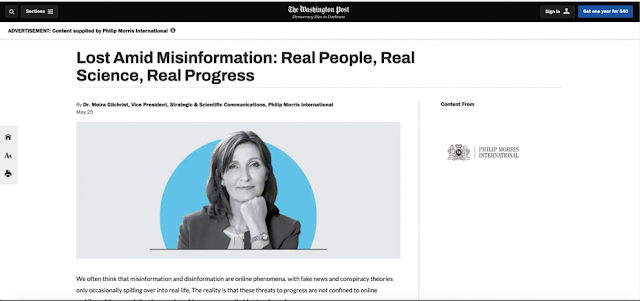
Speaking of disinformation, a topic that also highlighted to me was the use of propaganda and advertising in the form of news articles on media outlets. They look exactly the same, with headlines, photos, and polished writing, but are created by, or on behalf of, a paying advertiser. As a blog and magazine reader, I have seen thousands of these ads and haven’t given much value to them because I knew they weren’t 100% truthful. However, many people do not have the same understanding I do. 

Therefore, reading and thinking about it made me realize how this strategy called “native advertising”, but also tagged as “partner post” or “sponsored content”, can be prejudicial and deceive the public. Research studies have shown that those labels are ineffective at helping readers distinguish between an editorial and an advertising type of content. 

As an example, I will quote Michelle A. Amazeen’s article (Researchers looked at nearly 3,000 native ads across five years. Here’s what they found) published on Nieman Lab

“Philip Morris International, the tobacco company, ran a native advertising campaign across many media outlets, including The Boston Globe, The New York Times, Reuters, and The Washington Post (…) about the ‘disinformation campaigns that muddy the truth’ regarding the benefits of vaping products while themselves muddying the truth.” 


Another concern is that this kind of text is made by journalists. Many media companies have now content studios just to create native advertising in the name of corporate clients. It is understandable that a company needs money to survive and that it comes mainly from ads. Nevertheless, they should be responsible for the kind of content they publish and aware that it also might influence real journalism. 

Lastly, I want to rebound on Claire Wardle’s opinion about the challenge for the next two years. In 2017 she said it was “going to be a mixture of new technologies and how manipulation and disinformation work on those platforms and through those technologies.” By now, in 2022 – five years later, it seems like the challenge she mentioned is still pertinent and will last longer in the future.

References:


Graham, David A. 2019, Some Real News About Fake News, The Atlantic, accessed 13 February 2022, <https://www.theatlantic.com/ideas/archive/2019/06/fake-news-republicans-democrats/591211/>.


Wang, Shan 2017, The scale of misinformation online is global. First Draft is pushing for more collaboration — and more research — as an antidote, Nieman Lab, accessed 13 February 2022, <https://www.niemanlab.org/2017/11/the-scale-of-misinformation-online-is-global-first-draft-is-pushing-for-more-collaboration-and-more-research-as-an-antidote/>


Berman, Nina 2017, The Victims of Fake News, Columbia Journalism Review, accessed 13 February 2022, <https://www.cjr.org/special_report/fake-news-pizzagate-seth-rich-newtown-sandy-hook.php>.


*This article was submitted as a memo assignment for the course "Current Issues of Journalism" at the University of Illinois.
Published: By: Manu Ferreira - 2/11/2022 02:17:00 PM

Thursday, February 3, 2022

Who is a journalist? What are the qualifications and responsibilities?


Who is a journalist? It is a hard question to answer. Everyone can be a journalist when it comes to gathering information and sharing news. Years ago, we could say that what differentiates it is a bachelor’s degree, which in some places is not required anymore to practice the profession. So, how could we define it? 

Credit: Pixabay

The first thing I learned when I was in college, is that a journalist must be impartial do no matter what he has to cover or write about. He should always be objective regardless of his biases and beliefs. Now, I just learned a new meaning of objectivity. It is not about a person being objective, but the method used to precisely collect and test information. And this makes way more sense since we cannot disassociate ourselves from our background and experiences. 

Learning that made me realize that one of our main qualifications, besides writing techniques, is to be able to examine our own biases, be conscious of what we believe, and manage it, keeping them in or out of a story when they are inappropriate.

And his connects with the most relevant purpose of journalism, in my opinion, which is to serve the public interest. As Bill Kovach and Tom Rosenstiel say in The Elements of Journalism, is “the function news plays in the lives of people.” It is part of our role to choose which stories to cover, how to cover them, and also think of how they affect everyone's lives. After all, people can use the report to make decisions about their lives, communities, and societies. This decision-making, which is based on our biases, changes everything. 

Truth is the key

Speaking of responsibilities, telling the truth about facts is the first one. And to achieve that, we need to use our objectivity: find reliable sources, verify information, and make sure it is accurate and transparent for the audience. It is a commitment to citizens. This compromise also includes offering a voice to the voiceless and representing varied viewpoints and interests in society. 

One interesting point that I would highlight is the concentric sources of information. It emphasized the importance of verifying sources and classifying them according to their different levels. 

To sum up, we can define a journalist by the purpose of his work and by the methods used to check and produce a “functional truth”. I agree with the authors when they say that journalists no longer decide what the public should or should not know. Now, their main role is “to verify the information the consumer already has or is likely to find and then help them make sense of what it means and how they might use it.” 

In the same way that journalists have to be responsible for the content they create and share, people also need to be aware of the kind of information they consume, make their minds, and decide for themselves why they should believe it or not. That is why media literacy is essential.

References:


Leslie, Gregg 2009, Who is a "journalist"?, Reporters Committee for Freedom Press, accessed 03 February 2022, <https://www.rcfp.org/journals/the-news-media-and-the-law-fall-2009/who-journalist/>.


American Press Institute, Journalism Essentials, accessed 03 February 2022, <https://www.americanpressinstitute.org/journalism-essentials/>


*This article was submitted as a memo assignment for the course "Current Issues of Journalism" at the University of Illinois.

Published: By: Manu Ferreira - 2/03/2022 01:57:00 PM